The motor is a crucial core component of the internal drive system in power tools. What are the main differences between brushed and brushless motors?
Brushed Motor
Relies on the mechanical contact between carbon brushes and a commutator for commutation.
When powered, the carbon brushes rub against the commutator, continuously switching the direction of the current in the coils to keep the rotor spinning.
Brushless Motor (BLDC)
|
Item |
Brushed Motor |
Brushless Motor |
|
Commutation Mode: |
Mechanical commutation (carbon-brush friction) |
Electronic commutation (driver board) |
|
Wearing Parts: |
Carbon brushes, consumable parts requiring regular replacement |
No carbon brushes, almost no mechanical wear |
|
Service Life: |
Shorter. Power drops and sparking occurs when carbon brushes wear out |
Much longer, generally 3-10 times that of brushed motors |
|
Efficiency: |
Low efficiency, large friction loss and high heat generation |
Higher efficiency, power-saving, longer runtime with the same battery |
|
Maintenance: |
Carbon brush replacement required |
Practically maintenance-free |
|
Noise: |
Relatively loud noise caused by carbon-brush friction and electric spark |
Quieter operation |
|
Weight / Size: |
Larger and heavier at the same power rating |
Smaller and lighter at the same power rating |
|
Torque Feature: |
Average low-speed torque; obvious speed drop under load |
High low-speed torque, stable speed under load, excellent power output for power tools |
|
Cost: |
Low motor cost with simple structure |
Higher total cost for motor plus driver board |
|
Dust Resistance: |
Carbon brushes easily accumulate carbon dust, prone to failure in dusty environments |
Better sealing performance, more durable in dusty working conditions |
|
Heat Generation: |
Severe heat from carbon-brush friction |
Heat mainly generated from coils with optimized heat dissipation |
Lacks carbon brushes and a commutator; instead, it relies on an internal drive board (controller) for electronic commutation. Permanent magnets are located on the rotor and coils on the stator, with the controller adjusting the coil current in real-time to achieve rotation.
In summary:
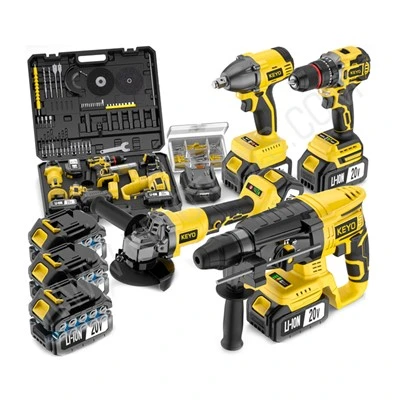
Advantages of brushless motors: When used in tools such as cordless drills, angle grinders, and rotary hammers, brushless models deliver higher output torque, extended battery life, and greater overall durability; they are less prone to burnout and can withstand prolonged, heavy-duty operation. Their downsides include a higher purchase price and significant repair costs should the controller fail.
Advantages of brushed motors: These tools have a lower purchase price and are easy to repair, making them suitable for light-duty or intermittent tasks. Their downsides are that carbon brushes are consumable parts prone to wear, and the motor tends to overheat and experience power loss during long periods of continuous operation.
However, a brushless motor is not necessarily the best choice for your needs. You should select power tools with the appropriate motor configuration by considering your target market, actual operating conditions, and specific application scenarios.